Into Practice

Whatever you have learned or received or heard from me, or seen in me—put it into practice. And the God of peace will be with you.

Philippians 4:9

Sometimes Christians wonder why they aren’t experiencing more peace in their life. After all, they believe the gospel, they believe in Jesus, yet they wonder where their peace has gone. We get a clue as to what happened in this passage.

The pathway to peace is putting it into practice. It’s not enough to learn, to receive, to hear or to see the gospel on display. We must actually take it and apply it to our daily life. When we put it into practice, when we obey–when we live it out–that is when we experience the God of peace who is with us.

For example, it’s not enough to learn that we must forgive because we are forgiven. It’s not enough to receive forgiveness and hear about forgiveness. It’s not enough to see forgiveness in action. All of those things help us gain understanding about what forgiveness is and why it is important, but they won’t bring us peace until we actually forgive the person who hurt us. It’s when we “put it into practice” that we experience the God of peace fill our hearts and minds with peace.

So if there is unrest or the absence of peace in an area of our life, we have to ask ourselves if we are putting the gospel into practice in that area. Often it is as simple as sitting quietly for a few minutes, listening to worship music, and asking the Holy Spirit to reveal anything that we aren’t putting into practice. Once the Holy Spirit brings it to the surface, thank Him, ask for forgiveness, and ask what it looks like to put it into practice. Don’t be surprised if you see pictures in your mind’s eye or hear thoughts that clarify what to do next.

Think about these things

8Finally, brothers and sisters, whatever is true, whatever is noble, whatever is right, whatever is pure, whatever is lovely, whatever is admirable—if anything is excellent or praiseworthy—think about such things. 

Philippians 4:8

Things that are true, noble, right, pure, lovely, admirable, excellent, praiseworthy…this is what your mind is supposed to be focused on as a follower of Jesus. That means we need to filter what is allowed to enter our mind.

We know that if we eat healthy foods, our body will be healthier. The same is true of our mind. What we allow to enter our eyes and our ears matters. The definition of immaturity is consuming everything the world offers and thinking it won’t affect the way we think and what we think about. We are trying to teach our kids to be mindful of what they hear and what they watch. And we never grow out of this truth. When Paul was writing this to the Philippians he was writing to adults.

What you watch on Netflix, Prime, HBO or Hulu matters. It matters what you see on screens, whether they are TV, computer, or phones. It matters what conversations you choose to participate in and what conversations you walk away from. What you allow in your eyes and ears will be what your mind tends to think about. So are those things true? Are they noble? Are they pure? How about lovely or admirable? Are they excellent or praiseworthy?

Just as our computers have filters on them to block inappropriate content (or they should if they don’t already) our minds need filters. Those filters are positioned on our eyes and ears. What will we allow in? If we notice that watching or listening to something causes seeds of sin to enter our heart and mind (like lust, anger, despair, racism, gossip, envy, self-righteousness, etc) then we need to cut it out of our lives.

This is what Jesus was getting at when He said, “If your right eye causes you to stumble, gouge it out and throw it away…”(Matthew 5:29). Jesus wasn’t speaking literally as if He was promoting self-mutilation. His hyperbolic language was supposed to help us understand the severity of leaving open gateways of sin in our lives.

Practically speaking, this looks like you stop watching that show. You stop watching or listening to the news (at least in that format). You don’t read that person’s post or article on Facebook. You don’t open your computer that late at night. You put your phone down and stop scrolling through images of “picture perfect families” or undressed women. You stop joining conversations where people are talking negatively about others at work…or church.

Your mind will produce the fruit of whatever you feed it. Feed it healthy things!

A Peace of God

Do not be anxious about anything, but in every situation, by prayer and petition, with thanksgiving, present your requests to God. And the peace of God, which transcends all understanding, will guard your hearts and your minds in Christ Jesus.

Philippians 4:6-7

In our prayer time with the Lord, there was meant to be an exchange. We come with our burdens, our heavy yokes, our anxiety, our worry, our stress, our frustrations, our failures, and we give them to God by prayer and petition.

Then we shift into gratitude, praise, and thanksgiving. This shift allows us to let go and receive all that He has for us in that moment. Many times we’ll feel God’s love; we’ll sense that He is with us and for us. There may be a release of joy that wells up from inside of us. But most often the thing that comes and wraps us like a blanket is the peace of God.

God’s peace transcends all understanding. It doesn’t make sense that we should be feeling such a calm and a peace in the midst of these storms of life, and yet that is exactly what we experience in God’s Presence.

Like a fresh coat of paint, God’s peace doesn’t just change the color of our heart and mind from dark to light, but it also seals, protects and guards our hearts and minds for the rest of the day. It protects us from the natural weathering that can happen to our emotions and our thought-life.

The Greek word here translated into the word “guard” refers to a military sentinel or guard. Another way of saying it is that God’s peace is militant. Sometimes we think of peace as a fluffy, white blanket. The connotation here is much stronger than a fluffy, white blanket. Picture instead a stern, special ops soldier assigned to be your body guard in a war zone. That is what the peace of God does as we get harassed by the anxieties of the world. It aggressively guards our hearts and minds.

Jesus said:

“Come to me, all you who are weary and burdened, and I will give you rest. Take my yoke upon you and learn from me, for I am gentle and humble in heart, and you will find rest for your souls. For my yoke is easy and my burden is light.”

Matthew 11:28-30

Everything A Loss

If someone else thinks they have reasons to put confidence in the flesh, I have more: circumcised on the eighth day, of the people of Israel, of the tribe of Benjamin, a Hebrew of Hebrews; in regard to the law, a Pharisee; as for zeal, persecuting the church; as for righteousness based on the law, faultless.

But whatever were gains to me I now consider loss for the sake of Christ. What is more, I consider everything a loss because of the surpassing worth of knowing Christ Jesus my Lord, for whose sake I have lost all things. I consider them garbage, that I may gain Christ and be found in him…

Philippians 3:4-9

I relate to Paul in this passage in so many ways. In seminary, I learned a lot. I met some of my best friends and met some of the greatest teachers. Some of those teachers have been life long models for me of Christ-likeness.

But there are so many things we were filled with in seminary, and it wasn’t the Holy Spirit. They taught us how to critique and doubt Scripture but not how to trust in it. They taught us how to deconstruct our faith but not how to rebuild it. They taught us to demythologize the miraculous stories of the Gospels, but they never taught us how to heal the sick, raise the dead, or cast out demons.

In other words, they taught us how to be a good Pharisee, a lot like Paul’s old life, but they didn’t teach us how to do ministry like Jesus and the disciples. They filled our mind with theology but didn’t fill our lives with the Holy Spirit. They imparted to us skepticism but never imparted the gifts of the Spirit. We became masters at reinterpreting passages of Scripture but not masters at submitting our lives to the word of God.

If anyone thinks they have reason to put confidence in their theological education, I have more. Indoctrinated by the third year; of the people who were moderate progressives; of the tribe of Emergents; a skeptic among skeptics. In regards to knowledge, a Pharisee; as for zeal, persecuting the Fundamentalists; as for righteousness based on cynicism, faultless.

Then I had a series of encounters with the Lord that changed everything. He showed me how my life, which I thought was full of healthy skepticism and cautious intellectualism, was really just full of unbelief. He showed me how toxic doubt had been in my life and how it had robbed me of a full life in Christ and had distanced me from the power of the Holy Spirit. He took me through a process of dismantling my resistance to Him. It took an overhaul of my heart and a renewal of the mind (Romans 12:2). And this process continues as He calls me into a bigger and bigger “Yes” with my life.

So now, whatever were gains to me in seminary I now consider loss for the sake of Christ. What is more, I consider everything a loss because of the surpassing worth of knowing Christ Jesus my Lord, for whose sake I have lost all things. I consider them garbage, that I may gain Christ and be found in him…

Now I pursue something totally different. My desires have been changed by these intimate and profound encounters with the Lord. “I want to know Christ—yes, to know the power of his resurrection and participation in his sufferings, becoming like him in his death…”(Philippians 3:10).

Father, purge out of me anything that is not of You. Get rid of all doubt and hesitation. Get rid of slow obedience and replace it with quick obedience. Get rid of fear and replace it with faith and trust.

Imitate Jesus

…have the same mindset as Christ Jesus:

Who, being in very nature God,
    did not consider equality with God something to be used to his own advantage
;
rather, he made himself nothing
    by taking the very nature of a servant,
    being made in human likeness.

Philippians 2:5-7

Paul tells us that though Jesus was God in the flesh, Jesus did not use His divinity as something He “used to his own advantage.” In the Greek the word here means “to take by an open display of force like someone seizing a prize or bounty.” In other words, rather than openly displaying the power of His divinity, Jesus instead set His divinity aside and “made himself nothing by taking the very nature of a servant.”

Paul learned this truth from Jesus Himself:

For this reason they tried all the more to kill him; not only was he breaking the Sabbath, but he was even calling God his own Father, making himself equal with God.

Jesus gave them this answer: “Very truly I tell you, the Son can do nothing by himself; he can do only what he sees his Father doing, because whatever the Father does the Son also does. For the Father loves the Son and shows him all he does. 

John 5:18-20

We see in this passage in John the same two truths that are articulated in Philippians 2: 1) Jesus was God in the flesh, and 2) Jesus made himself completely dependent on the Father, not operating out of His divinity but rather His humanity. If Jesus was operating out of His divinity it wouldn’t be true that “the Son can do nothing by himself.”

Instead, Jesus operated as a human who was fully connected to the Father and completely filled by the Holy Spirit (Luke 4:1), walking in the power of the Spirit (Luke 4:14). By doing so He became our example, not just our Savior.

If Jesus operated out of His divinity, Christianity becomes a spectator sport where we get to say, “Well, yeah, but Jesus was God!” We never have to take up the call to imitate Jesus because that seems impossible. But by Jesus operating completely out of His humanity, we don’t get that excuse. We are now invited to fully connect to the Father and be completely filled and empowered by the Holy Spirit just as Jesus modeled and just as the first century Christians attempted.

When Jesus healed the sick, cast out demons and raised the dead, He did so as a human who was fully connected to the Father and fully empowered by the Spirit. Then He turns to His disciples, who are in no way divine, and commands them to do the same things (Matthew 10:1-8; Luke 10:1-21; Matthew 28:19-20). And we see the disciples do what Jesus had been doing. They just needed the authority of Jesus (Matthew 10:1; 28:18; 2 Corinthians 5:20) and the power of the Holy Spirit (Luke 24:49; Acts 2:4, 43) in order to perform some of the same signs and wonders.

All of this leaves us without excuse. The whole, “Yeah, but Jesus was God” excuse doesn’t really work. Jesus is our example, and we are to imitate His life. Paul put it this way, “Follow my example, as I follow the example of Christ”(1 Corinthians 11:1). He also said, “Follow God’s example, therefore, as dearly loved children…”(Ephesians 5:1).

I Had A Dream

“We both had dreams,” they answered, “but there is no one to interpret them.” Then Joseph said to them, “Do not interpretations belong to God? Tell me your dreams.”

Genesis 40:8

Joseph was a dreamer (Genesis 37:5-9) like his dad Jacob (Genesis 28:12-17). Joseph, like the prophet Daniel (Daniel 2 & 4), was also able to interpret dreams through the gift that God had given him.

Dreams are one of the primary ways that God talks to people. One reason this seems to be the case is that it is one of the only times our rationality doesn’t get in the way of God speaking. Dreams from God are often highly symbolic and need the help of an interpretation in order to understand them. It’s like the creative writer who has to find a way for their inner editor, the rational side of the brain, to be quiet so that their creativity can emerge. Otherwise, they experience writer’s block. If they are able to silence their critical thinking, they get into a zone where the creativity flows and the story takes on a life of its own.

This is the same reason God speaks to us in our dreams. He wants a blank canvas on which to paint without our doubts, cynicism, criticism, and rationalism plugging our ears.

A few weeks ago a guy in our church had a dream where he was told to go back for prayer after one of our church services. He obeyed what God told him to do in the dream, received prayer for physical healing, and he was healed! It wasn’t an audible voice of God in His dream, but more of an impression. It was just slight enough to ignore if he wanted to and yet just strong enough to obey if he was willing to step out in faith. He chose to obey, stepped out in faith, and he got healed.

I was praying for a friend the other day, and I asked the Lord to reveal the source of some of her struggles. A few days later she had a dream that highlighted the main source of some of her issues. The Holy Spirit answered our prayer by giving her a dream. The dream made things crystal clear.

I value counseling and psychology. I was a Family Studies minor in college where our main focus was learning the dynamics of family systems theory. Psychology is important and valuable. Unfortunately, parts of it have led us to devalue our dreams. Our culture chalks our dreams up to being totally from our subconscious or some weird reaction to the food we ate the night before. And while this is true of some dreams, it is not true of all dreams.

Our dreams have three sources: 1) our subconscious; 2) the enemy and his kingdom of darkness; or 3) the Holy Spirit. We need to pay attention to our dream if it seems meaningful or significant. It could be a way God is trying to speak to us. We may need others to pray with us for discernment and for an interpretation. If we have dreams that are full of fear, terror, or disturbing and dark imagery, it may be an attack from the enemy. If it doesn’t seem to have a message and doesn’t seem to be significant, it may just be our subconscious or something we ate. All three are real possibilities.

But just because it isn’t always the Holy Spirit doesn’t mean that it is never the Holy Spirit. Many people who say, “I just don’t hear from God,” don’t understand the different ways that God can communicate with us.

Right now, throughout the Middle East, hundreds and hundreds of Muslim people are having dreams of a man in white who says his name is Jesus and who sends them to go talk to a local missionary in order to hear more about who He is. Muslims are coming to faith in Jesus by the hundreds through these kinds of dreams.

In the Bible, dreams have always been a way God speaks to people, and dreams will continue to be a way He speaks today.

Depth of Insight

And this is my prayer: that your love may abound more and more in knowledge and depth of insight, so that you may be able to discern what is best and may be pure and blameless for the day of Christ, 

Philippians 1:9-10

Occasionally in the Paul’s letters, he writes out his prayers. This is one of the prayers he prays for the believers in the city of Philippi.

His prayer is that their agape love would abound more and more. But how would this unconditional, Christ-like love grow in them? He prays that their love grows in two areas: knowledge and depth of insight.

The word here in the Greek for knowledge isn’t gnosis, which is the standard word. The word here is epignosis, which means “knowledge gained through first-hand experience or relationship.” Paul didn’t want them to amass more information and think that was going to grow their love. What they needed was personal relationship with Jesus, first-hand encounters with the Holy Spirit that helped them gain more knowledge about who God is and what He is like.

The Greek words that form the phrase “depth of insight” are the words for “all or every” and a word that means “perception, understanding or discernment.” Literally it could be translated “every perception.” The root of this word for “perception” is used when Jesus tries to tell His disciples that He is going to be crucified.

While everyone was marveling at all that Jesus did, he said to his disciples, “Listen carefully to what I am about to tell you: The Son of Man is going to be delivered into the hands of men.” But they did not understand what this meant. It was hidden from them, so that they did not grasp it…

Luke 9:43-45

The disciples did not grasp it. They could not understand it. They couldn’t perceive the reality of it. This is the same word used in Paul’s prayer when he prayed for the Philippians to have “insight.” The way that they will grow in their love for God and for other people is if they can grow in their understanding, depth of insight, and perception of the truth.

Love is not the fullness of itself unless it is combined with understanding and truth. We’ve seen enablers perpetuate the addiction of their loved ones and call it love. We’ve seen domestic violence victims protect their abuser from criminal prosecution and call it love. Everything that feels like love and looks like love isn’t always love. We need our love to abound more and more in knowledge and depth of insight in order for it to really be love.

And we see this happen on so many issues today to well-meaning Christians. In their attempt to be loving, they leave behind knowledge and depth of insight. In doing so they limit their ability to be “able to discern what is best,” what is “pure and blameless.”

Confirmation

The church at Philippi was definitely one of Paul’s favorites. The apostle Paul writes from prison and starts his letter to the Philippians with this:

I thank my God every time I remember you. In all my prayers for all of you, I always pray with joy because of your partnership in the gospel from the first day until now…It is right for me to feel this way about all of you, since I have you in my heart and, whether I am in chains or defending and confirming the gospel, all of you share in God’s grace with me.

Philippians 1:3-5, 7

It’s a beautiful thing to have partners in the gospel like this. But what I want us to notice here is how Paul describes his own ministry. He mentions three distinct times when he truly feels the Philippians’ partnership as they share in God’s grace with him: 1) when he’s in chains; 2) when he’s defending the gospel, and 3) when he’s confirming the gospel. Christians around the world can relate to these three realities. However, in the American Church, we can mostly only relate to the second one.

When Paul mentions that he “defends” the gospel, he uses the word apologia. This is the Greek word where we get our English word apologetics. It is when we use intelligent reasoning to defend the foundational principles of the gospel.

Yet, Paul also describes his ministry as confirming the gospel. Most American Christians would read this and assume it is the same as defending the gospel. But that is not what Paul is saying here. The Greek word meaning “to confirm” is also used in Mark 16:20:

Then the disciples went out and preached everywhere, and the Lord worked with them and confirmed his word by the signs that accompanied it.

Mark 16:20

So while intelligent reasoning is what it takes to “defend” the gospel, the confirmation of the gospel happens through demonstrations of the power of God through signs and wonders. Paul says it this way to the Romans:

I will not venture to speak of anything except what Christ has accomplished through me in leading the Gentiles to obey God by what I have said and done—by the power of signs and wonders, through the power of the Spirit of God. 

Romans 15:18-19

Christians around the world are experiencing all three of the things Paul mentioned in Philippians 1. They are being imprisoned and persecuted for their faith. They are defending the gospel with the reasoned truth. But they are also confirming the gospel through healings, miracles, and casting out demons–the power of signs and wonders.

One reason American Christians are steeped in unbelief, doubt and skepticism is because the Church here is largely unable to confirm the gospel. If we spend all our time defending the gospel, we’re constantly on the defense. Confirmation of the gospel, through signs and wonders, is what is needed in our generation!

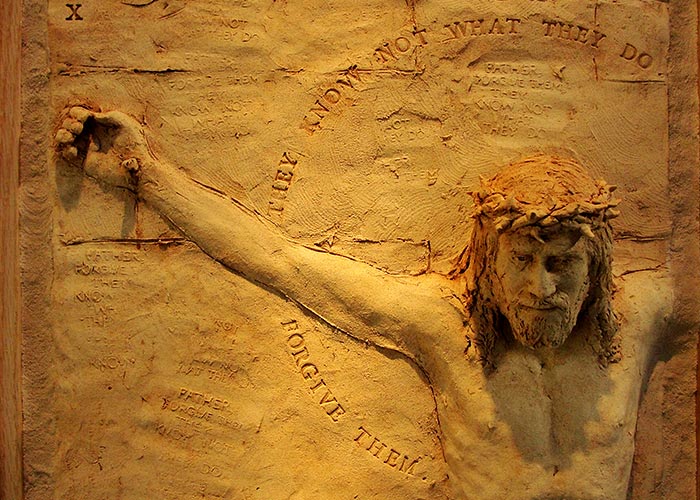
Jesus is Crucified

horizondaily's avatarhorizondaily

10-Station By Lynne Kiefer Kobylecky, Our Lady of Guadalupe Trappist Abbey

And they crucified him.

Mark 15:24

Overwhelmed with sorrow in Gethsemane, arrested like a common criminal, accused falsely in court, denied by His best friends, chosen for death by a crowd of His own people, sentenced by an immoral pagan, mocked and spit on by Roman soldiers, crowned with thorns, beaten brutally, depleted by the laborious and staggering walk to Golgotha, Jesus finally laid down on his soon-to-be bier—two splintered beams of roughly hewn wood. Those tasked with His death offered Him a homeopathic narcotic, but He refused.

And they crucified him.

Four words in English, three in the original Greek. Such punctuated words for such a monumental event — the kind of event that needs to be slowed down in order to be seen.

Right arm stretched out and tied down. Left arm stretched out and tied down.
The…

View original post 335 more words

Roman Spear

And pray in the Spirit on all occasions with all kinds of prayers and requests. With this in mind, be alert and always keep on praying for all the Lord’s people. 

Ephesians 6:18

Out of all the armor listed in Ephesians 6 there is one major weapon missing that Roman soldiers would have always had with them. The spear was their main offensive weapon. While fighting may have eventually devolved into hand-to-hand sword fighting, it would have started with a phalanx of shields and spears.

While Paul doesn’t specifically call prayer the “spear of the Spirit,” by putting it last in the list, that is the impression we get. By the time Paul got to the end of this list of armor, the Ephesians would have all been wondering, “But what about the spear?” Its absence was too conspicuous to miss. By Paul concluding with the need for prayer “on all occasions” he was saying that prayer is our main offensive weapon, just like the spear for the Romans.

But what is praying in the Spirit? Is Paul talking about praying in tongues here?

In 1 Corinthians 14, Paul does connect praying in the Spirit with praying in tongues:

For if I pray in a tongue, my spirit prays, but my mind is unfruitful. So what shall I do? I will pray with my spirit, but I will also pray with my understanding; I will sing with my spirit, but I will also sing with my understanding. Otherwise when you are praising God in the Spirit, how can someone else, who is now put in the position of an inquirer, say “Amen” to your thanksgiving, since they do not know what you are saying? You are giving thanks well enough, but no one else is edified.

1 Corinthians 14:14-17

I believe praying in tongues is one of the ways to pray in the Spirit but is not the only way. I believe praying in the Spirit means that we are not just saying cursory prayers, but that we are connected to the Holy Spirit as we pray. I believe we are praying in the Spirit any time we connect our hearts and minds to the Holy Spirit’s leading as we pray.

When we pray in the Spirit, we not only launch javelins in the spirit realm for the sake of the people we are praying for, but there is also a “building up” that happens to us as we pray. Jude says:

But you, dear friends, by building yourselves up in your most holy faith and praying in the Holy Spirit, keep yourselves in God’s love as you wait for the mercy of our Lord Jesus Christ to bring you to eternal life.

Jude 1:20-21

In Romans, Paul articulates how praying in connection to the Holy Spirit helps us as we pray:

In the same way, the Spirit helps us in our weakness. We do not know what we ought to pray for, but the Spirit himself intercedes for us through wordless groans. And he who searches our hearts knows the mind of the Spirit, because the Spirit intercedes for God’s people in accordance with the will of God.

Romans 8:26-27

In the Ephesians 6 passage, Paul is clear that praying in the Spirit can take the form of “all kinds of prayers and requests.” This means that praying in the Spirit can look like intercession, prayer of petition, prayer of command, prayer of praise, declarations, praying in tongues, and even just silent listening prayer as we wait on the Lord. Praying in the Spirit is more about the connection between our heart and the heart of God and less about what comes out of our mouths.

Some of the most powerful prayers I’ve ever prayed were never articulated in words at all. They were times when I was simply weeping over someone as my heart connected to the heart of God.